As a big history nerd I’m so excited about today’s visit. When in the most northern islands of Scotland you’re likely to be in the Orkney Islands. These islands have been inhabited for more than 8,500 years. From 875 to 1472 Denmark claimed these islands as their own. It was in 1472 that Scotland absorbed Orkney into the Kingdom of Scotland, following failure to pay a dowry promised to James III of Scotland by the family of his bride, Margaret of Denmark. Kirkwall is the capital of the Orkney region of islands.
If you know nothing about Scotland you’ve heard the weather is always cold, windy and rainy. The weather gods have gifted us with a glorious day. I suppose all the rain does make things really beautiful.

Unlike cities to the north, this region is not painting anything with vivid colors. Most buildings and streets look similar to this.

Continuing up the hill you’re faced with the big draw of the town of Kirkwall. Welcome to St Magnus Cathedral, Britain’s most northerly cathedral.
Catholics and Christians have their pilgrimage which ends in Camino de Santiago in Spain where bones of St. James reside. Catholic Vikings (Norse) have their own 58-mile pilgrimage which ends at this church to visit the bones of St Magnus.

Started in 1113 in tribute to a man who had a reputation for piety and gentleness, it took 400 years to complete. It is mostly made from red and yellow sandstone. Looking at the exterior it’s easy to see how the brick material changed over the years.


Initially started with Norman architectural elements. As the building continues construction and styling changes over time, it pivots to gothic styling.

Upon opening the church allowed the most devote individuals to be buried
in the floors. In the 1600s people started to be able to buy their way
into being buried here. Burial was simply lifting some stones, digging
dirt out, place the body in, throw dirt back in, tile over with a pretty
stone. As no coffins were used a stone could be picked up, dirt pulled
out again, new body placed, over and over many times. From this location all the way to the rear of the church, left and right, was full of bones from hundreds of people.
In the 1800s as
bodies and soil settled the floor was warped plus there were odd smells
filling the church. It’s decided all the bones are coming out. 700 years
worth of bones are pulled out and all placed outside the church in a
giant unmarked pit along with other people who couldn’t afford a private
burial. Just proves in the end, we all end up equal in the end.

Once they pulled out all the bones they didn’t know what to do with some
of the more well preserved headstones. If you’ve been in Europe you’ve
likely seen something like this before but they were worn down. The
church decided to highlight some of the best ones as semi-art pieces.

Nearly all the stones have the same elements. Hour glass to represent our days which are constantly expiring, skull and bones to remind us we all met the same fate. In one was created by a husband that lost his wife and kids “..in hopes of a blessed resurrection”.

New flooring tile was recreated during that 1900s.

A reason I was so excited to visit here is all the wild history which happened in this church. In the below photo, above the yellow circle, was the dungeon. After all, the church for a while was all things, part worship center, part tribunal. Originally the chamber was accessed from an upper chamber where prisoners would be deposited via a chute, although a more humane ladder was added later. Men and women were housed here starting in the mid 1500s and housed folks as late as the eighteenth century.

Being this far north allowed the town to evade much destruction from the world wars. From the below photo you’d think the stained glass looks modern and that’s true. What forever changed the church was the Reformation where the region quickly moved from a Catholic to a Protestant country. Why is that significant? Protestants don’t recognize saints.
Following the death of Mary, Queen of Scots the built-up anger of the locals was let free. They went to the church and destroyed, defaced, stole anything Catholic in nature – including the original stained glass.

Passion was so strong they managed to get their way up to the roof of this structure.


Once reaching the top of the roof they painted over all the frescos. During the 1900 renovation one square had the stucco removed which showed a faint idea how detailed the ceiling had been.

First time I’ve seen an memento mori plaque in a church. With roots in classical antiquity and Christianity, the phrase translates to “Remember (that you have) to die”.

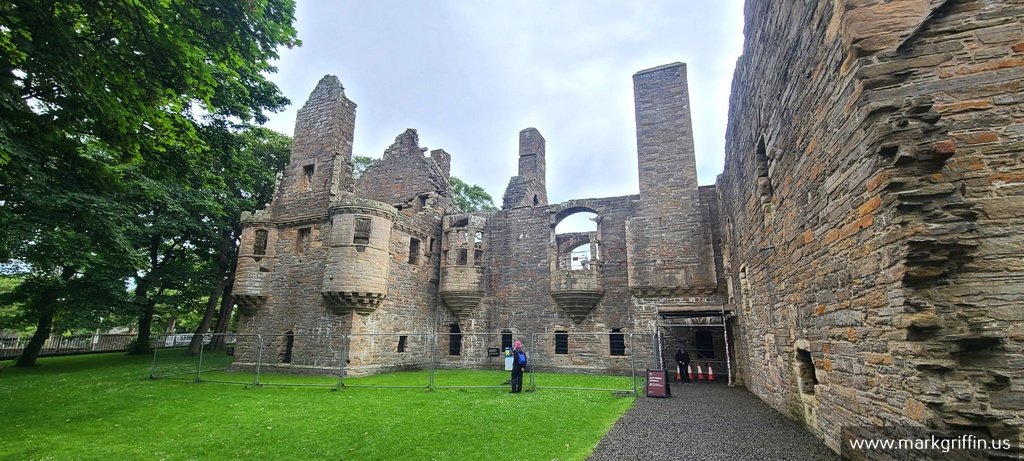
There’s some time to kill until something special takes place. Head outside and across the street. Here is home to the most tyrannical noblemen in Scotland’s history – Patrick Stewart, 2nd Earl of Orkney.

The Earl’s Palace dates back to 1600 when the bishop of the region didn’t like his 1200 provided home. Dude is young (mid-teenager), has power, some some clout, massive ego and won’t let anything or anyone prevent him getting his desires met. He’s such an evil person that, after he marries a wealthy widow, he blows through all her money, he leaves her and she dies in poverty. Where did some of that cash go? Helps to build his mini fortress.

He’s vicious to the locals during his time here, makes false claims of crimes against all sorts of people, even plots a rebellion against some key leadership people. When word gets out of how mental this guy is and all the chaos that’s happening, the Scottish kingdom comes after him. A five-week war breaks out against this place. 140 canon balls are shot at it, all which just bounced off the walls or just split in half. Eventually they drag the spoiled 22-year old out, put him on trial and behead him.

Time to head back across the street, past the cemetery and to today’s tour.

St Magnus Cathedral’s happens to be the only church which allows tours to all levels of the building. In a short wile we’ll be popping through all those holes and walking above that wood ceiling.

This tour is extremely limited. Only eight people, twice a week are allowed. Upon checking in you’re shown photos of what to expect on the excursion. I’m thinking to myself, no biggie.

Enter the first doorway and off we go.

These stairs are original to construction from the 1200-1400s.

At the first level you’re seeing how stacked shale is used to make arches and columns.

Here you’re also able to see the generic glass that was introduced after Reformation destruction.

That second level is where the dungeon / prison had been.

Look close enough you can see doorway which lead to the cells.

Hope you’re not afraid of heights. At this level you’re amazed how all this was done with such primitive tools.

The public gets to see the pretty stones. In reality, its a large volume of small, cheap shale and mortar which keeps this building standing.

Reaching the first level of arches you’re displayed artifacts. For centuries the locals used this space as a bit of a garage, keeping oddities here.

From below the arches give the illusion of being extremely deep, yet were rarely ever used for anything.

In the late 1800s the church falls into deep disrepair. The local
sheriff (royal official responsible for enforcing law), dies and leaves
some $8million dollars to the church for renovations. A great bid is created asking the community how to make the building look like it originally did. One response was this depiction of creating scripture art within each of the arches.

As these lofts were storage units for so long, at some point locals decided to put up a ladder which had been used for escorting the executioner and criminal to the gallows before hanging or beheading. Imagine how tall the structure had been for needing this tall of ladder. Rungs are worn down heavily on one side as the executioner had to do two trips as opposed to the other side which was a one-way journey.

During the 1900s renovation, the Reformation glass work is pulled out and stored up here.

Leaving here we pass by some of the 1900s new stain glass work.

400-years of work is so visible from the second level. Pretty stone is used on lower floors while fill is placed higher.

Moving to the third level, things start to get really tight. I’m forced to walk sideways as my shoulders don’t fit going squarely to passages.

Quick explanation of how the cathedral clock works
Fourth floor passage. Steps now are called toe-steps, for obvious reasons.

By far this is the steepest and tiniest of steps I’ve ever encountered anywhere.

What a reward awaits you. Here’s the bell tower.

How did people in the old ages know if they were late for church service?
Higher we must go.


Welcome to the fifth floor. Below us are the bells. Remove the wood brace from this doorway….

… which leads you out the tower …

… cross some planks …

… and you see the most beautiful seaside views.


Doing all those steps looks a little like this…
After roughly 10 minute we proceed down. Going up the stairs is cake compared to going down.

This experience is where you’re rewarded for being short as well as having tiny feet. I really feel I’m going to stumble and roll the entire length of this staircase.

I survived! Another view of the spiral which we had just been walking around.

Unlike other northern cities, the town is drab in building colors. So surprising the contrast to other regions that have rough winters.

This isn’t your typical tourist street but it is authentic.

Finally, after three weeks of drab, bland fried ship food, a meal with flavor!

It’s almost unheard of visiting northern Scotland where the weather is in the 60s. Such a beautiful region under the sunny skies.

Looking back to the downtown area. You can just make the church out.


The sendoff from the town is like that from Norway. Hearing their song choice hits differently. John singing “Ob-La-Di Ob-La-Da, life goes on” sums up this trip perfectly. Beautiful highs seeing all the unique landscapes along with the disappointments of missing out from witnessing some unspoiled landscapes, life does indeed go on.
In the words of Hamlet, which we saw at the beginning of this trip – until the next adventure, Adieu.