When researching this trip it was hard to find much info about Isafjordur other than the witch trial of 1656. Haven’t heard of the trial? Feel free to skip this next part if you’re reading this to learn about the city.The plaintiff in the trial was pastor Jón Magnússon (author), who had been suffering poor health since 1654. He contended that his illness, as well as what he described as demonic disturbances in his household and in the surrounding district, were brought on by sorcery practiced by two members of his own congregation, who also sang in the choir, a father and son both named Jón Jónsson. The elder Jón confessed to owning a book about magic and that he had used it against the pastor. The son also confessed to having made the pastor ill and of having used magical signs and farting runes against a girl. The curse of farting was intended to be relentless; to not only humiliate the victim, but also to bring about chronic abdominal discomfort and weakness. Both father and son were found guilty of sorcery and were executed by burning at the stake. After they were executed, the priest was awarded all their material holdings.
The more you travel the more you realize witch trials were everywhere in the 1500-1600s.
Today’s port is just west of yesterday’s location. Even though, at first glance, you’d think you were visiting the islands of Hawaii with the tall hills and green walls.

Just 3000 people live here.

Beautiful hills surround the town and port.

Looking up things to do in Isafjordur and you see lots of walking or
food/beer tours. That’s not my speed. The only thing which was different
was a trip to the Hesteyri. Yeah, never heard of it either. Let’s take a 2-hour boat ride to see what this is all about.
All the mountains in Iceland are almost perfectly flat as a result of the last ice age. As glaciers moved through the region they ground off the softer tops and left the very hard volcanic rock.

2-hours later there are blips of what look like homes.

A small town?

And we’re here.

The history of this village starts at the end of the 19th century when Norwegians set up a whaling station not far from where the village. In 1915, the station closed when Iceland imposed a 10 year ban on whaling in Icelandic waters.
Hesteyri village was established after that closure. There was a school, a shop, a church, a post office with telephone communication and a local doctor’s house. Children in nearby villages would walk 4 hours to attend school here. By 1956, Hesteyri was completely abandoned after the nearby cannery closed. Today, there are about 10 houses remaining, mainly used as Summer houses by the old inhabitants and their families. No one is allowed to purchase housing or land in Hornstrandir. The doctor’s house is used as a summer café and guesthouse in Summer, when hikers come here to start their mountain traverses.


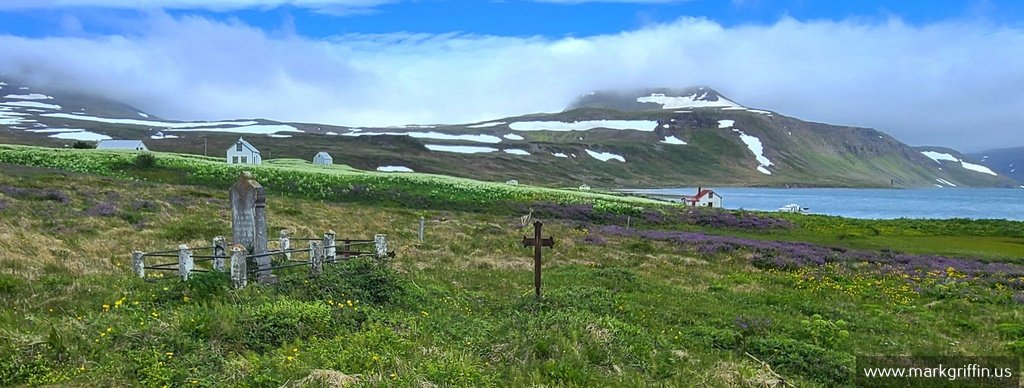
Where I’m standing to take this picture had stood a church. With the town closed, one day the local governor had a need for a new church roughly 10 miles away. No need to pay for one to be built. He authorized the dismantling and reassembly of the church in the new location. It still stands there today. All that remains of the church is the stone flooring and the church bell.

Snow melt makes a beautiful stream which flows to the ocean.

.jpg)

Before heading back the local ‘hotel’ offers us fresh bread, a cinnamon crepe and slice of rhubarb crumble pie. A spectacular dining venue was also included.


And that’s it. Less than an hour visit here. A beautiful hour for sure. Back to the dock then back to the ship.

Technically three sea days ahead of us with the middle sea day being a transit of a glacier fjord. Tonight’s program includes a captain talk about the upcoming visit to Greenland. Can’t wait to learn what’s on tap for the next week.