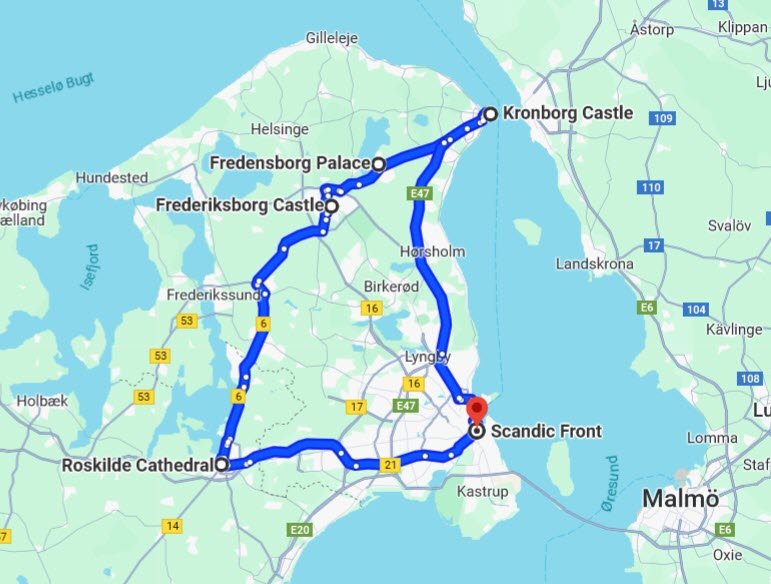
Here’s the original plan for yesterday. Only one little problem – there’s no actual train route from Roskilde to the eastern castles. Today we’ll do the second half.
Read more: Day 3 – Fredensborg and Kronborg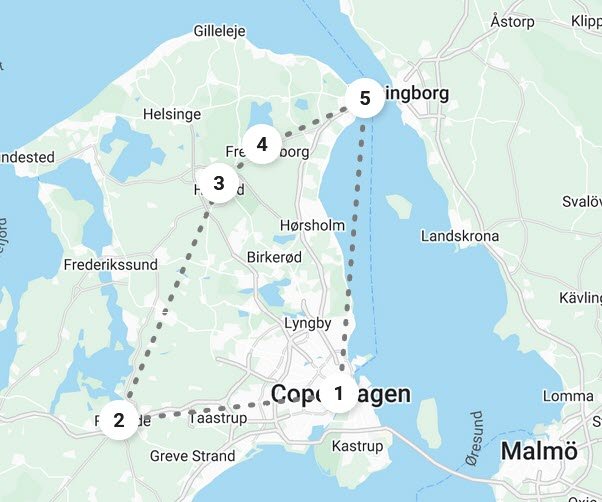
Quick trip through tomorrow’s venue before reaching the train station.

Off to Frederiksborg and Kronborg Castle. These places aren’t as unfamiliar to you as you might expect.
An hour later and we’re in Frederiksborg. The old town is a 15 minute walk from the train station. Apparently the castle is near the town.

I think I found it.

Not a bad view to take in while napping.


Many think Frederiksborg Castle is a copy of Versailles in France. In reality this castle is older as it was built in 1560s and was the first castle built purely for pleasure and recreation rather than defense.

While it wasn’t built with defensive components, folks back then still had a degree of paranoia so a grand wall needed to be build all around the grounds.

Make it through the first outer gate and you need to pass through the prison tower.


I bet a lot of relaxing years took place here for the king and queen.


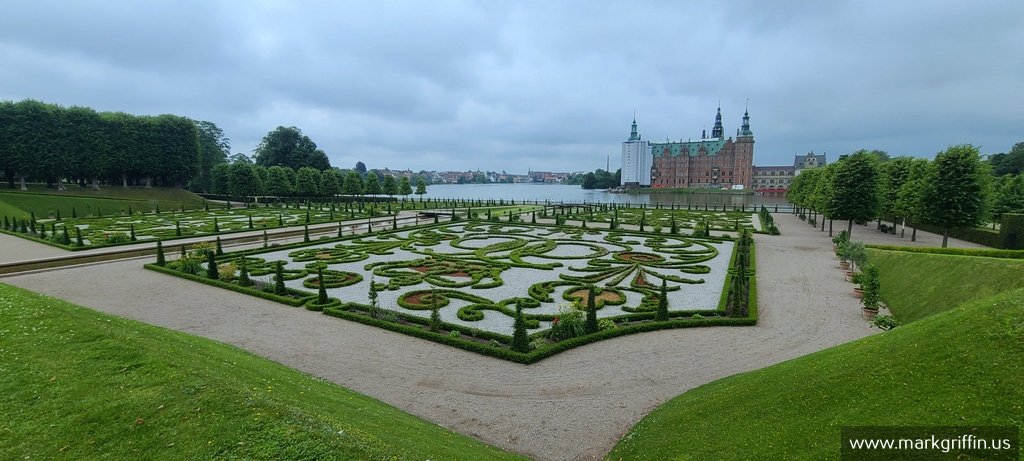
I’m here a bit early so let’s explore the gardens, located behind the castle.

This is a common scene in all the towns I’ve visited. Cities wanting to preserve their landmarks but not having the deep pockets so they create this complicated love hate relationship with tourists. In this case, tourism dollars are helping restore the main castle. Here’s a mural above the garden entrance that will be worked on next, not a moment too soon.

When you needed an escape the king would go to the Bath Palace.

The Bath Palace, naturally, sits on a natural spring.

Close enough to be in view of the main house without being in the house.

Care to enjoy an evening walk through the gardens?

Let’s make a quick stop first Louise’s island. This is something straight out of Marie Antoinette’s retreat at Versailles.

When Frederik 7 made the romantic part of the castle garden, he established the lakes Badstuedammen and Ødammen. At Louise’s Island, he built a log cabin, a miniature of a Norwegian manor. The plantation on the island consists of pine and birch trees to illustrate Norwegian nature. The Norwegian theme was meant to recreate a small piece of lost Norway that Denmark had to abandon in 1814.

The gardens were created in the 1700s. Around this time it seems the kingdom of Denmark begins a downward spiral. They become apathetic and, dare I say lazy. You can see this in the gardens. The gardens of Versailles were started in the mid-1600s. Frederik IV wants a copy of his own so he commissions the baroque gardens area.

The result, while beautiful, is a close copy to Versailles.

—————————————————–
—————————————————–

In 1859, a major fire tore through Frederiksborg whilst King Frederick VII was in residence – it being the depths of winter, the lake was frozen and little water was available nearby with which to douse the flames. Serious damage was done, but remnants of the interior and over 300 paintings were saved.
The left wing of the castle mostly avoided the fire. This is where the private church resides. Below is an original door leading into the church.


Upon entering the castle you’re brought into the main dining room.


What the fire missed – the 1606 private church.


Yes the organ is original. It is still played each Thursday for half an hour. It requires someone to play the keyboard and someone to stand behind the keyboard, pulling rope to add air to the chambers.


There is something so beautiful in the punch metal art the Russians created to portray religious stories.

This is the Privy Passage which leads you into the Audience Chamber.

When officials, clergy, and ordinary people had audiences with the king, it took place in the Audience Chamber.

In the bottom right of this photo is a chair, popping up from a trap door. The king wanted a way to discretely dip out of the party so they created a bit of an elevator for him. After all, why would you want to remain with important people needing guidance if you don’t really give a rip what happens.

Just one of the most beautiful ceilings in the castle.

Wisely they placed giant mirrors on the floor so you can see the details.


One of the receiving bedrooms. Special people could see the king in his suite, after he had woken for the day, naturally.

Painting saved from the great fire. Gives you an idea what life was like here in the 1700s.

Above the church is the Great Hall.

Queen, observing her party.


Capturing the winter when the castle set a fire. It could be seen throughout the region.

That was a great visit, well worth the trip. A quick walk back to the train station before we head to our second stop today.

———————–
Back on the train for another 30 minutes. This next castle is along the coast so the water becomes more visible on the journey.

We’ve reached the end of the line.

Welcome to Helsingør.

For the literature fans in the audience, Helsingør use to go by the name “Elsinore”. Yes, that Elsinore – the kingdom from Hamlet. This is the castle Shakespeare based one of his most famous stories.

From the train station, it’s impossible to miss just how impressive the location is on the peninsula.


Kronborg Castle has existed at Helsingør since 1420, during the reign of the Danish king, Eric of Pomerania. King Eric extracted a fee payment — “Sound dues” — from ships wishing to pass through the strait on the way to or from the Baltic Sea. To help enforce his payment demands, he built a powerful fortress at the narrowest point in the strait. At the time, the Kingdom of Denmark extended across both sides of the waterway, and Helsingborg Castle had been in existence on the opposite, eastern shore since the Middle Ages. With the two castles and a fleet of guard ships, it was possible to control all navigation through the strait.


Of course the main church of the town with it’s high tower is situated in a location where it’s impossible not to see and hear the bells.

From the previous narrative, this was designed to be a fortress of war. Battery walls are thick and moats are deep.


Even if you breached the outer walls you had to get past another moat and even higher walls where, due to the heights and holes of the wall, would have you shot or stabbed by the royal guard soldiers.


As this fortress needed to feed some 1000+ troops, along with the royal family, the grounds needed to be large as it not only would be a place for assembling people during war but also as a place of social gatherings during peaceful times.
Under the castle were where troops lived, livestock was kept warm, and the crypt existed. Living quarters are the lower three stories of the building. The roof-floors are all for storing things like hay, barley, oats, grains.

Those red upper doors were where supplies were hoisted up and brought in for storage.


Some of the beautiful, massive art pieces.

Unlike Frederiksbor, this building is pretty stark and empty. It’s like they don’t know how to furnish it.

One of the most impressive features is the grand hall. Back in the day all walls here would have had massive tapestries to not only keep the room warm but also to teach the history of the rulers of the day.


Yes this is also the same hall where young Hamlet dies due to a poisoned sword, as re-enacted here.


This little exhibit is clever as it shows how the hall would have looked back in the day with all the tapestries hung.


A small 170 steps up the tower and we’re on top of the tower.

Small entrance to the private church, directly under another of the supply hoist rooms.


Climbing the 170 steps and you see the beautiful surroundings, including the outer homes of the support staff.


Sadly there’s no tours going to the very top.

From here you can see how it would be impossible to pass the channel without paying your tax to the kingdom.


Amazingly, some of the original tapestries which hung in the great hall still are alive. You can get an idea how grand the hall must have been covered endlessly with these hand-crafted pieces, each telling a different story.

Much like how the Catholic church used picture scriptures to indoctrinate their servants, these tapestries also were used to remind the mostly illiterate visitors of these grand people and why they needed to be admired even after death

Each unit is some 25-30 feet tall and the detail is mind-blowing.

You did read that, in the crypt of the castle, the silent soldier was waiting for when Denmark needed saving. Here is that soldier.


Well, that’s the castle. Have to admit, I’m disappointed. This was the most expensive of all locations to see (almost double) and it didn’t give much for the money. If you’re thinking of visiting on your trip, maybe come here after you’ve seen everything in Denmark as well as Norway (it’s on the other side of the water).

Walking back to the ship I hear that same wild noise as I heard yesterday. Today was their high school graduation. All students get into the back of these trucks and are whisked away to different homes of their classmates where they get more drunk and more drunk. When driving, they blow their whistles and the locals clap, cheer and celebrate the festivities.

Quick lunch pit stop.

Then back on the long train ride to Copenhagen.

Here in the far northeast, the countryside is really beautiful.

Tomorrow is the activity I’ve tried twice before. Let’s hope this third time is the charm because I’ve got a boat to catch that afternoon.