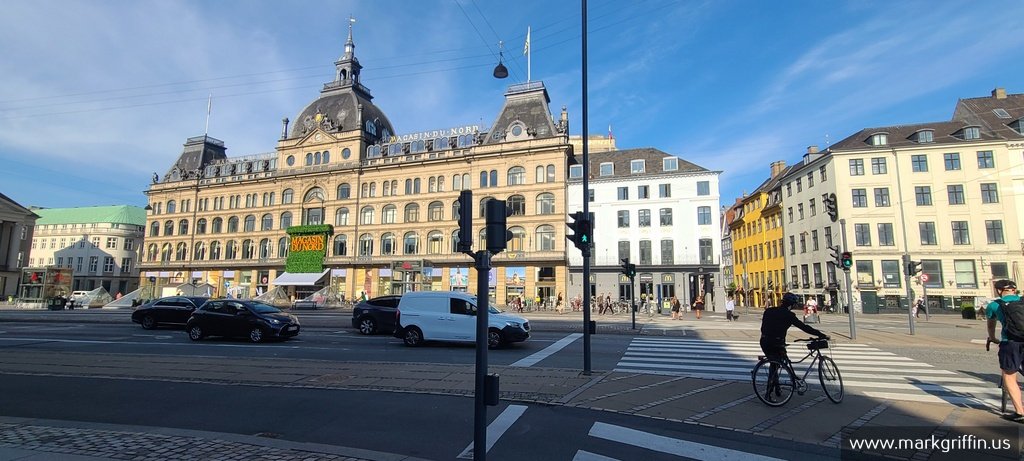
That midnight sun is killer on sleep when you need to keep windows open all night for the cooler ocean air. 7am and it’s time to get deeper into Denmark. Today we’re heading an hour-ish west to Roskilde.
Best part about being out so early, all the tourists and locals are still asleep.

This is the first time I’ve visited a city where, to get to the subway system, you decide how many levels under street level you wish to travel.

Back to the train station. Not sure I learned a lot from yesterday’s journey through here but let’s see.

It’s clear how old this station is. Everything is old wood, naturally bent to create all the arches.

Have to be careful when riding their train system not to sit in first class. All you have, at best, is a small sign saying Standard or Enhanced class.

Roughly an hour later we’re in Roskide.
Roskilde has a long history, dating from the pre-Christian Viking Age. Its UNESCO-listed Gothic cathedral, now housing 39 tombs of the Danish monarchs, was completed in 1275, becoming a focus of religious influence until the Reformation. The town developed as the hub of the Viking land and sea trade routes over a thousand years ago, is one of Denmark’s oldest cities. From the 11th century until 1443, it was the capital of Denmark.

A quiet public square. Remember this red building as we’ll come back here later in the day.

For now, we’re heading to the cathedral.


Ah Danish pastries. Not only are they extremely delicious, it seems eating then never causes you to gain weight. Everyone here enjoys them.


Welcome to the Roskilde Cathedral. Building of it began in 1100.


This is now the resting place for most of the kings of Denmark. Each time they ran out of space for the tombs they just added a new wing. As a result there’s no overall structural organization due the decades of new space being needed.


Despite all the wars over the decades, this place is pretty in tact. Here, these yellow buildings were built in 1856.


Pay a small admission fee, get this great guide to understand all the people buried here. Notice the woman’s face on the guide. She’s important. We’ll learn about her shortly.


The couple in the image below were visiting ahead of their wedding ceremony. What a stunning place this would be to get married within.

Some of the detail of the choir benches.


As this was built as a holding place for important rulers and not so much for regular church service, I think it’s time we see some of these grand tombs.
One of the most striking spaces is for Christian IX of Denmark. Christian was not a great king. In fact, he was quite terrible, losing many wars, creating policies that angered most in the country. Even the heir of England despised this guy, refused his offer for marriage, which later resulted in him having to marry is second cousin. In spite of all this, in the 1900s the population started liking anyone in a monarch position, so folks came around to him before his death. He did get a grand chamber.


In the northern arm stands the double sarcophagus of Christian IX and his Queen Louise. Designed by Hack Kampmann, the sarcophagus was originally to have stood in the eastern arm of Frederick V’s chapel. Surrounding the sarcophagus are three statues of female figures, designed by Edvard Eriksen. The statues are named “Grief”, “Memory”, and “Love” and were cut from white marble from Carrara in Italy. The statue of “Grief” bears a notable resemblance to the statue of the Little Mermaid in Copenhagen, which is not without reason. Edvard Eriksen had created the statue of the Little Mermaid in 1911, two years before he created the statues in the chapel, and his wife Eline Eriksen was model for both.


Beautiful alter.


Going behind you’re reminded these alters were created, in part, to be able to be taken apart should war break out. It’s not glamorous but it does what is necessary to hold that much weight.

Remember the program we received when walking in? Let’s learn who that figure was. It’s no coincidence her tomb is directly behind the high alter.
Margaret I was Queen regnant of Denmark, Norway, and Sweden (which included Finland) from the late 1380s until her death in 1412, and the founder of the Kalmar Union that joined the Scandinavian kingdoms together for over a century. Margaret was known as a wise, energetic and capable leader, who governed with “farsighted tact and caution,” earning the nickname “Semiramis of the North”. She was also known by her subjects as “Lady King”, which became widely used in recognition of her capabilities. Knut Gjerset calls her “the first great ruling queen in European history.”
In 1363, at the age of ten, Margaret married Haakon VI. In 1370, they had a son, Olaf. Following the deaths of her husband and son, Margaret was proclaimed queen of the Scandinavian kingdoms. She was ultimately succeeded by a grandnephew, Eric of Pomerania. Although Eric came of age in 1401, Margaret continued for the remaining 11 years of her life to be sole ruler in all but name. Her regency marked the beginning of a Dano-Norwegian union which was to last for more than four centuries. During her time as ruler she restored fiscal responsibilities to the nation by ditching paper currency for silver coins and made a point to use a considerable portion of her wealth to dispense to charities. To this day a special bell is being rung twice daily in commemoration of the Queen.


Frederik V was the King of Denmark-Norway from 1746; son of Christian VI and Sophie Magdalene of Brandenburg-Kulmbach. In 1743 he was married to Louise of Great Britain, and the year after her death in 1751 to Juliane Marie of Brunswick-Wolfenbüttel. With Louise he had several children, including Christian (VII).

Construction began in 1774, taking inspiration from Rome, and it was inaugurated in 1825. The white maidens represent Denmark and Norway and are dressed in Greek gowns


The life like nature they managed to capture in the marble stuck me. You almost believe the clothing is made of actual cloth due to the movement and flowing nature of the carved patterns.

—————–
https://www.youtube.com/embed/NYJ_QsdPSss?si=Gd7RNYu5xZkCOKgU
——————
Quick selfie


Quick view to the second level. Sadly, only on Monday afternoons are you allowed to climb to the top of the bell towers.


Time to leave the cathedral and go back to that red building by the water fountain we saw when entering town. Here stood one of the original churches in town. This would have been built at the same time the cathedral was constructed. When they were originally built, they were small as they only had wood to build structures.

Over time the build was lost and buried several times over to gain space for different uses over the decades. Eventually historical interests resulted in the city wanting to uncover the original church foundation.

Descend a level down from the street level and you see the original church floor and the stunning tiles.


In the photo below to the far right is where the present water features resides in the town square.

There is also a tower on top of the present church location. This tower has evolved over time. At moments it had been a prison as well as a lookout for war ships. Steps here are not for the faint of heart. Extremely tight and narrow, even by European standards.


While climbing up I’m hearing all this noise coming from outside. Once at the top I saw what was happening. Today was high school graduation day. Apparently, when you graduate, you and your friends travel by school-sponsored bus to the nearest fountain and wash off your youth.
Keep in mind, in Denmark, people can go to bars and buy beer at age 15, wine at 16. Now, today is hot again. These kids are showing up on these buses wanting to party. They’ve been drinking since who knows when. You can imagine the scene happening here, including teachers passing out beer to the former students (and yes I saw one girl fall, drop her glass beer in the fountain, spin around, whack her head on the edge of the fountain, scratching up her back really badly. But that didn’t stop the party!

Enough of that chaos. Time to head back to the train station. While wondering back I stumbled upon the most beautiful cemetery I’ve seen. Between or at the base of the trees or bushes are tomb markers.


Entrance to the 1856 cemetery.

As pretty of a place as any to gain lunch. Not bad for 13USD.

Back in Copenhagen you’re constantly stumbling upon these tiny public squares. This one happens to be a great spot for purchasing plants.

I’ve earned a treat!

8USD for all this. So delicious. Croissants rival those found in Paris.

9pm, clouds are rolling in. Hoping the weather stays so tomorrow’s exploration of eastern Denmark can happen.

Last photo to show how close my room is to the ‘beach’.
