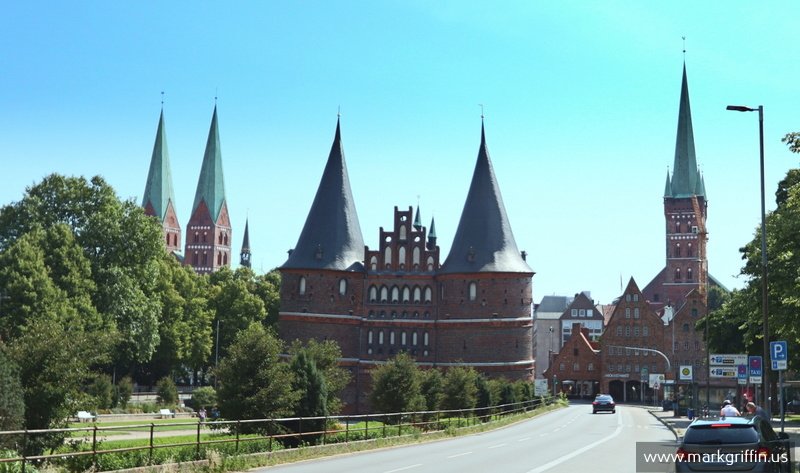
As shared earlier, this trip I’m on is quite odd. MSC to start with is an odd line as they do have people join and leave in almost all ports. Today is the finale of the ‘regular’ sailing passengers with 50% disembarking. We”re technically in Kiel, Germany which is in the northern part of Germany.
After an 1.5 hr drive we’ll be in the city of Lubeck. That city was founded in 819 by the Slavs and later an important port for the Roman Empire, Napoleon, the Swedes, Prussia and finally the Nazi’s where they were added into Germany. Thankfully the people never bought into the whole Nazi thing. In fact, it angered Hitler so much when the region blocked his visit that he basically cancelled its independent statehood and made it an extension of Hamburg. The people have been part of independent statehood, socialists and imperialistic nation statehood. If there was ever a region that’s seen it all, it’s Lubeck.
 |
| Some of the views as we head towards Lubeck |
Welcome to the town of Lubeck.
 |
| This use to be part of a strong city wall. Depiction here shows how it looked in 900 AD. |
 |
| Over time the circle halls were added |
 |
| The back side of that wall / city entrance |
 |
| Wonder what kind of furnishings fit in that room |
 |
| You can almost imagine what it was like living within the city walls |
 |
| No real building codes back then so things were often off |
 |
 |
| A few buildings survived the WW2 bombings. White is new, red is original |
|
 |
| You see how the Swiss / Dutch architecture influenced the town |
|
|
|
|
|
|
|
|
|
|
|
|
|
|
|
|
|
 |
| Everywhere are these tiny courtyards. We’ll go in that church in a moment. |
 |
| You see what was original pre-WW2 and what was reconstructed |
 |
| This organ is the oldest organ in the world, dating back to 1400s |
|
This next church is the oldest in Germany with construction beginning sometime in the 1200s. Rich people had extra money so they built a hospital for the sick. Once constructed they weren’t sick so they allowed the poor, single to use it. When feeling well the rich folks continued to pay for the running of the facility. Three times a day the people that were here had to pay to the rich people that they’d stay healthy and not need the beds. Morbid huh?
 |
| Yes the center is crooked. Over time it settled at an angle |
 |
| Pretty hospital |
 |
| Eventually the pews were pulled out and individual bedrooms installed |
 |
| This helps to show how the building was broken up |
 |
| It actually did pretty well in the war |
Ok, sea day tomorrow then we’re in Norway!